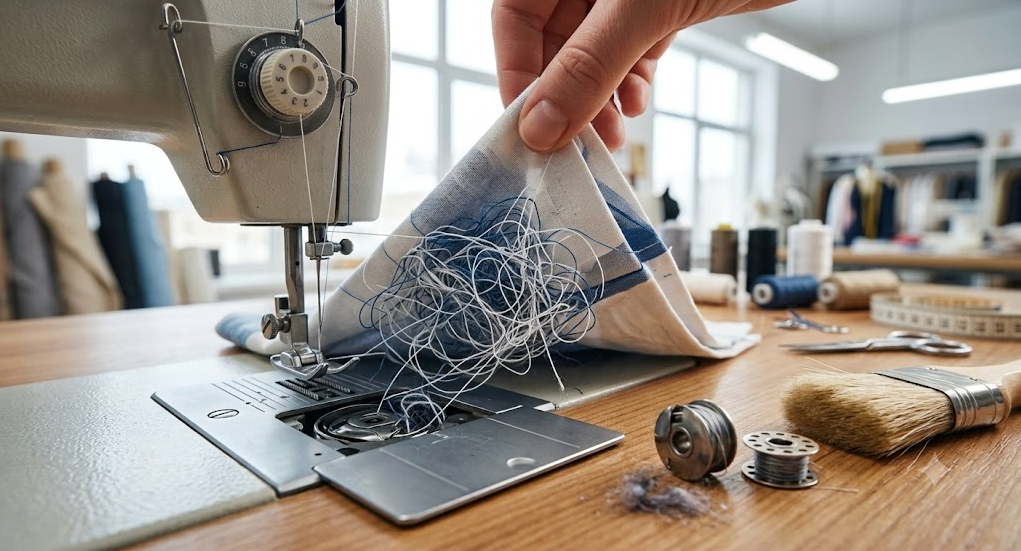
Few things are as frustrating as stepping on your pedal or presser foot only to find a huge, tangled nest of thread clumped underneath your fabric. Known in the tailoring trade as "bird nesting" or thread bunching, this issue halts boutique production runs and domestic stitching alike.
Whether you are using a classic pedal machine (Merritt, Singer, USHA), a modern zig-zag electric fashion maker (Brother, Singer, Bernette), or a high-speed industrial lockstitch machine (Jack, Juki, Siruba), thread bunching points to specific mechanical or tension imbalances.
What Really Causes Thread Bunching?
A common misconception is assuming the problem is inside the bobbin just because thread collects at the bottom. In reality, bottom loops are almost always caused by a lack of upper tension or path obstruction.
- 1. Improper Thread Tension & Missed Take-Up Lever: If the upper thread is not seated firmly between the tension discs or slips off the take-up lever, the needle pulls loose loops down into the shuttle race without pulling them back tight.
- 2. Lack of Cleaning (Lint & Dust Build-up): Accumulated lint packed between the feed dogs, under the needle plate, or inside the shuttle race disrupts smooth thread passage and stalls the hook timing.
- 3. Low-Quality Thread & Substandard Bobbin Cases: Uneven, hairy, or brittle local threads shred easily under tension. Warped or low-grade local bobbin cases cause erratic bobbin rotation and sudden tangling.
- 4. Burrs or Scratches on the Hook Set / Shuttle Race: When a needle strikes the rotating hook, it leaves sharp microscopic burrs. The top thread snags on these burrs on every rotation, collecting into a giant nest underneath.
- 5. Burrs in the Needle Plate Hole: A bent needle repeatedly hitting the throat plate hole creates jagged metal edges that fray and trap the thread.
- 6. Incorrect Needle Position or Sizing: Inserting a needle backwards (flat side facing the wrong direction) or using the wrong needle system (e.g., using round shank DBx1 in a domestic flat-shank machine) disrupts stitch loop formation.
Step-by-Step Solutions: How to Stop Thread Nesting
- Re-thread with the Presser Foot UP: Always raise the presser foot before threading your machine. This opens the upper tension discs, allowing the thread to slide deep inside for proper resistance.
- Clean the Bobbin Area & Feed Dogs: Remove the needle plate and bobbin case. Use a lint brush to sweep out packed lint, fluff, and loose thread bits.
- Switch to Genuine Spares & Quality Spun Thread: Replace warped metal or plastic bobbins with genuine OEM bobbins. Use smooth, high-tenacity branded thread.
- Inspect and Smooth Out Metal Burrs: Run a fingernail along the needle hole and hook tip. If you feel roughness, smooth it using fine 1200-grit emery paper or replace the damaged component.
- Install a Fresh Needle Correctly: Ensure the flat side of the needle faces the correct direction according to your machine's manual, push it all the way up into the clamp, and tighten securely.
Professional Doorstep Service Across Coimbatore & Surrounding Regions
Tried re-threading and tension tuning, but your machine still keeps looping or breaking thread? Mechanical timing misalignment, damaged rotary hooks, and worn tension assemblies require professional calibration.
We provide comprehensive doorstep sewing machine repair, timing restoration, and genuine parts replacement across:
- Coimbatore: Gandhipuram, RS Puram, Peelamedu, Singanallur, Saibaba Colony, Saravanampatti
- Pollachi & surrounding rural tailoring hubs
- Mettupalayam & foothills
- Ooty / The Nilgiris: High-altitude boutique and home tailor care
Supported Brands: Singer, Jack, USHA, Merritt, Juki, Brother, Siruba, and all umbrella pedal machines.
Don't let thread bunching slow down your orders! Call or WhatsApp us at +91 8778799127 to book a doorstep service appointment today.